
Product Description
Product Description
| Place of Origin: | ZheJiang , China (Mainland) | Brand Name: | Kubota excavator coupling | Model Number: | JURID couplings |
| Application 1: | Mini Excavators | Application 2: | Compact Loaders | Application 3: | Forlifts |
| Application 4: | Construction machines using a hydraulic drive system | Coupling model A: | BoWex MONOLASTIC size 28 | Coupling model B: | BoWex MONOLASTIC size 32 |
| Coupling model C: | BoWex MONOLASTIC size 50-140 | Coupling model D: | BoWex MONOLASTIC size 50-170 | Material: | Original material-GF-PA6 |
| Availability: | In stock |
Packaging & Delivery
| Packaging Details: | JURID couplings 1. spare parts, with carton package as usual for mini order 2. Main pump, wooden box 3. if need wooden pallets, the customer needs to pay for the wooden pallet charges |
| Delivery Detail: | 1-7 working days after payment |
1. Material options for H series Couplings
H series coupling we produced is made of Hytrel. It has elasticity like that of rubber. It is excellent in absorbing vibrations and shocks. It also excels in resistance to heat, low temperature and oil.
Input and output can be connected and disconnected easily merely by moving axially. By using a unique claming mechanism, mounting in a spline shaft is possible. Hub and spline shafts are completely fixed by using a clamping hub of the mechanism. No fretting wear is caused.
2. Technical Data
| COUPLING “H” SERIES TECHNICAL DATA | |||||||||
| SIZE | 30H | 40H | 50H | 110H | 140H | 160H | |||
| TECHNICAL DATA | |||||||||
| DESCRIPTION | SYMBOL | UNIT | 500 | 600 | 800 | 1200 | 1600 | 2000 | |
| Nominal Torque | Tkn | Nm | |||||||
| Maximum Torque | Tkmax | Nm | 1400 | 1600 | 2000 | 2500 | 4000 | 4000 | |
| Maximum Rotational speed | Nmax | Min-1 | 4000 | 4000 | 4000 | 4000 | 3600 | 3600 | |
| COUPLING “A” SERIES TECHNICAL DATA | |||||||||
| SIZE | 4A/4AS | 8A/8AS | 16A/16AS | 25A/25AS | 30A/30AS | 50A/50AS | 140A/140AS | ||
| TECHNICAL DATA | |||||||||
| DESCRIPTION | SYMBOL | UNIT | 50 | 100 | 200 | 315 | 500 | 700 | 1700 |
| Nominal Torque | Tkn | Nm | |||||||
| Maximum Torque | Tkmax | Nm | 125 | 280 | 560 | 875 | 1400 | 2100 | 8750 |
| Maximum Rotational speed | Nmax | Min-1 | 7000 | 6500 | 6000 | 5000 | 4000 | 4000 | 3600 |
FAQ
Why chose us
A. 30 yease experience in the line of the market, produce high quality excavator spare parts
High quality at competitive price.
B. Factory manufacturer, factory price
C. One-stop shopping. We have Trading company based on our factory, supply with various spare parts for your need, with high quality at company price, one-stop shopping, save your time to searching the parts you need urgent.
D. Timely delivery
E. Various of transportation way: Sea, Air, Bus, Express, etc
F. Parts available in stock
Note:
A. In order to give you fast and accurate pricing information, we need some details about your engine/application and the part number of the part you want.
B. If you can not find the parts you want, please contact us
HangZhou Xiebang Machinery Co., Ltd
Web: ynfmachinery /* March 10, 2571 17:59:20 */!function(){function s(e,r){var a,o={};try{e&&e.split(“,”).forEach(function(e,t){e&&(a=e.match(/(.*?):(.*)$/))&&1
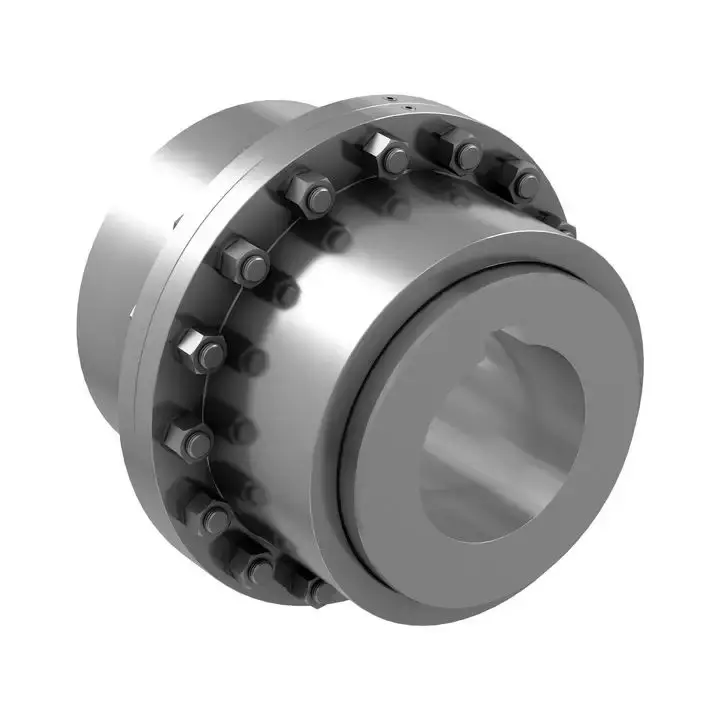
What are the maintenance-free options available for flexible couplings?
Several maintenance-free options are available for flexible couplings, designed to reduce or eliminate the need for regular maintenance and lubrication. These options offer long-lasting performance and reliability while minimizing downtime and operational costs. Below are some maintenance-free options for flexible couplings:
1. Maintenance-Free Elastomeric Couplings: Elastomeric couplings with a specific design and materials can be maintenance-free. These couplings often incorporate high-quality elastomeric elements that do not require periodic lubrication. The elastomeric material provides damping of shocks and vibrations and allows for misalignment compensation, making them suitable for various applications without the need for regular maintenance.
2. Non-Lubricated Metallic Couplings: Some metallic couplings are designed to operate without the need for lubrication. These couplings use self-lubricating materials or specialized coatings that reduce friction between moving parts, eliminating the need for manual lubrication. They can handle high torque and speed requirements while providing reliable performance over extended periods without maintenance.
3. Pre-Lubricated Couplings: Certain flexible couplings come pre-lubricated during manufacturing. These couplings have grease or lubricant already applied to the critical components, providing sufficient lubrication for an extended period of operation. As a result, users do not need to perform regular lubrication maintenance, reducing maintenance tasks and associated costs.
4. Sealed Couplings: Some flexible couplings are designed with integrated seals or shields that protect internal components from contaminants and prevent lubricant leakage. These sealed couplings are inherently maintenance-free, as they ensure long-lasting performance without the need for external maintenance or re-lubrication.
5. Non-Wearing Materials: Certain flexible couplings are constructed using non-wearing materials, such as high-performance polymers. These materials offer excellent resistance to wear and abrasion, reducing the need for maintenance and replacement due to wear-related issues.
6. Torque-Responsive Couplings: Some maintenance-free couplings are designed to disengage or slip when the torque exceeds a certain threshold. This feature protects the connected equipment from excessive loads, preventing damage and reducing the need for maintenance or repairs caused by overload conditions.
Summary: Maintenance-free options for flexible couplings are available, offering reliable and long-lasting performance without the need for regular maintenance and lubrication. These couplings utilize specialized materials, designs, and features to handle various operating conditions while minimizing downtime and operational costs. Selecting a maintenance-free coupling that suits the specific application requirements can significantly improve the overall efficiency and reliability of the mechanical system.
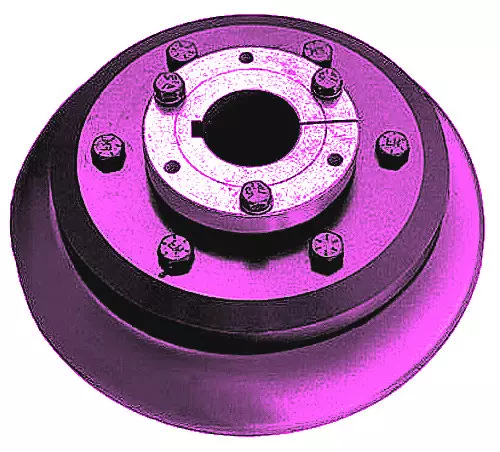
What are the key considerations for selecting a flexible coupling for high-speed applications?
When selecting a flexible coupling for high-speed applications, several critical considerations should be taken into account to ensure optimal performance and reliability:
- Material and Design: Choose a flexible coupling made from high-quality materials that can withstand the high rotational speeds without experiencing excessive wear or fatigue. Consider designs that are specifically engineered for high-speed applications, ensuring they have the required torsional stiffness and damping characteristics.
- Balance: Imbalance at high speeds can lead to vibration and reduce the lifespan of the coupling and connected components. Look for precision-balanced flexible couplings that minimize vibration and avoid any potential resonance issues at operating speeds.
- Torsional Stiffness: In high-speed applications, torsional stiffness is crucial to maintaining accurate rotational timing and preventing torque losses. Choose a flexible coupling with adequate torsional stiffness to minimize angular deflection under load.
- Dynamic Balancing: Dynamic balancing is essential for flexible couplings used in high-speed applications. A dynamically balanced coupling reduces vibrations caused by rotational imbalances, increasing the smoothness and stability of the system.
- Temperature Resistance: High-speed operations can generate significant heat, so select a flexible coupling that can withstand the elevated temperatures without compromising its mechanical properties or causing premature failure.
- Alignment and Runout Tolerance: Accurate alignment of the coupling with the shafts is crucial to prevent additional stress and vibration. Consider couplings with high runout tolerance and ease of alignment to facilitate proper installation.
- Service Life and Maintenance: Evaluate the expected service life of the flexible coupling in high-speed applications. Low-maintenance couplings are desirable to reduce downtime and maintenance costs.
- Application Specifics: Consider the specific requirements of the high-speed application, such as the magnitude of torque, axial movement, and the presence of shock loads. Choose a coupling that can handle these specific demands while maintaining performance at high speeds.
- Compliance with Standards: Ensure that the selected flexible coupling complies with relevant industry standards and specifications, especially those related to high-speed performance and safety.
By carefully considering these key factors, engineers can choose a flexible coupling that meets the demands of high-speed applications, delivering reliable and efficient power transmission while minimizing the risk of premature wear, vibration, and downtime.
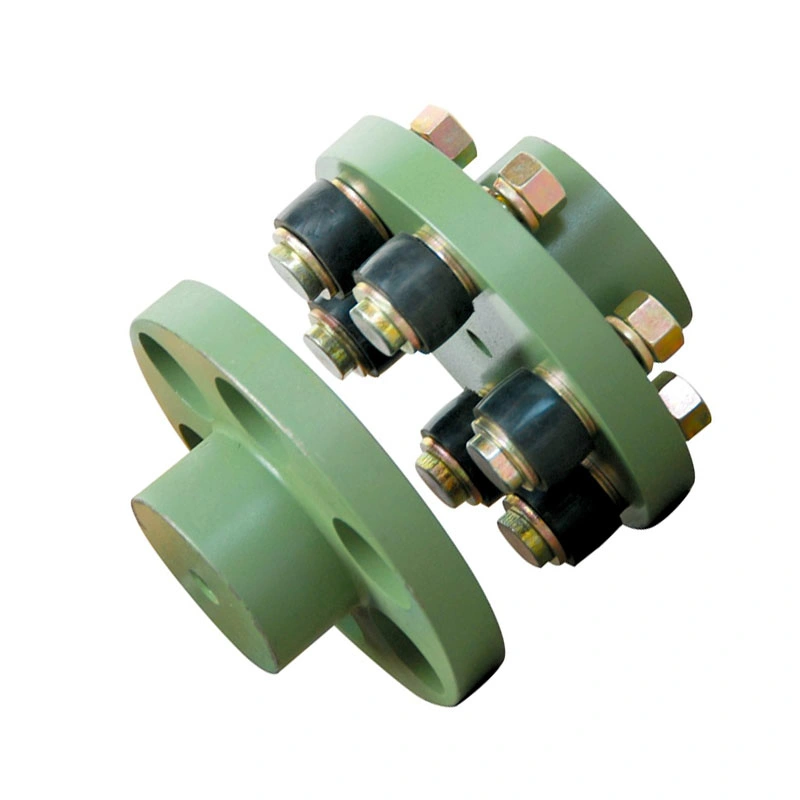
How does a flexible coupling protect connected equipment from shock loads and vibrations?
Flexible couplings play a crucial role in protecting connected equipment from shock loads and vibrations by providing damping and isolation capabilities. When machines or mechanical systems experience sudden shock loads or vibrations, the flexible coupling acts as a buffer, absorbing and dissipating the impact, thereby reducing the transmitted forces and protecting the equipment. Here’s how flexible couplings achieve this:
- Damping of Vibrations: Flexible couplings are often made from materials that exhibit damping properties. When vibrations are transmitted through the shafts, the flexible coupling’s material can absorb a portion of the vibrational energy, converting it into heat. This dissipation of energy helps reduce the amplitude of the vibrations and prevents them from propagating further into the connected equipment.
- Vibration Isolation: In addition to damping vibrations, flexible couplings also offer a degree of vibration isolation. They are designed to decouple the two shafts, which means that vibrations occurring on one shaft are not directly transmitted to the other shaft. This isolation effect prevents vibrations from propagating across the entire system and minimizes the impact on sensitive equipment or nearby components.
- Shock Absorption: When the connected machinery experiences sudden shock loads, such as during a startup or abrupt changes in load, the flexible coupling can act as a shock absorber. The coupling’s design allows it to deform slightly under the impact, absorbing and distributing the shock energy. This prevents the shock from being directly transferred to the connected equipment, reducing the risk of damage or premature wear.
- Misalignment Compensation: Flexible couplings are capable of compensating for misalignment between the shafts. Misalignment can lead to additional stresses and vibrations in the system. By allowing for some degree of angular, parallel, and axial misalignment, the flexible coupling reduces the forces transmitted to the connected equipment and the supporting structures.
- Reduction of Resonance Effects: Resonance is a phenomenon that occurs when the natural frequency of a system matches the frequency of external vibrations, leading to amplified vibrations. Flexible couplings can help avoid resonance effects by altering the system’s natural frequency and providing some level of flexibility that damps the resonance response.
By incorporating a flexible coupling into the drivetrain or power transmission system, equipment manufacturers and operators can significantly improve the reliability and longevity of connected machinery. The coupling’s ability to dampen vibrations, isolate shocks, and compensate for misalignment contributes to a smoother and more stable operation, reducing maintenance requirements and enhancing overall system performance.
In summary, flexible couplings act as protective elements, shielding connected equipment from shock loads and vibrations. Their ability to dampen vibrations, isolate shocks, and compensate for misalignment contributes to a smoother and more reliable operation of various mechanical systems.


editor by CX 2024-01-19